

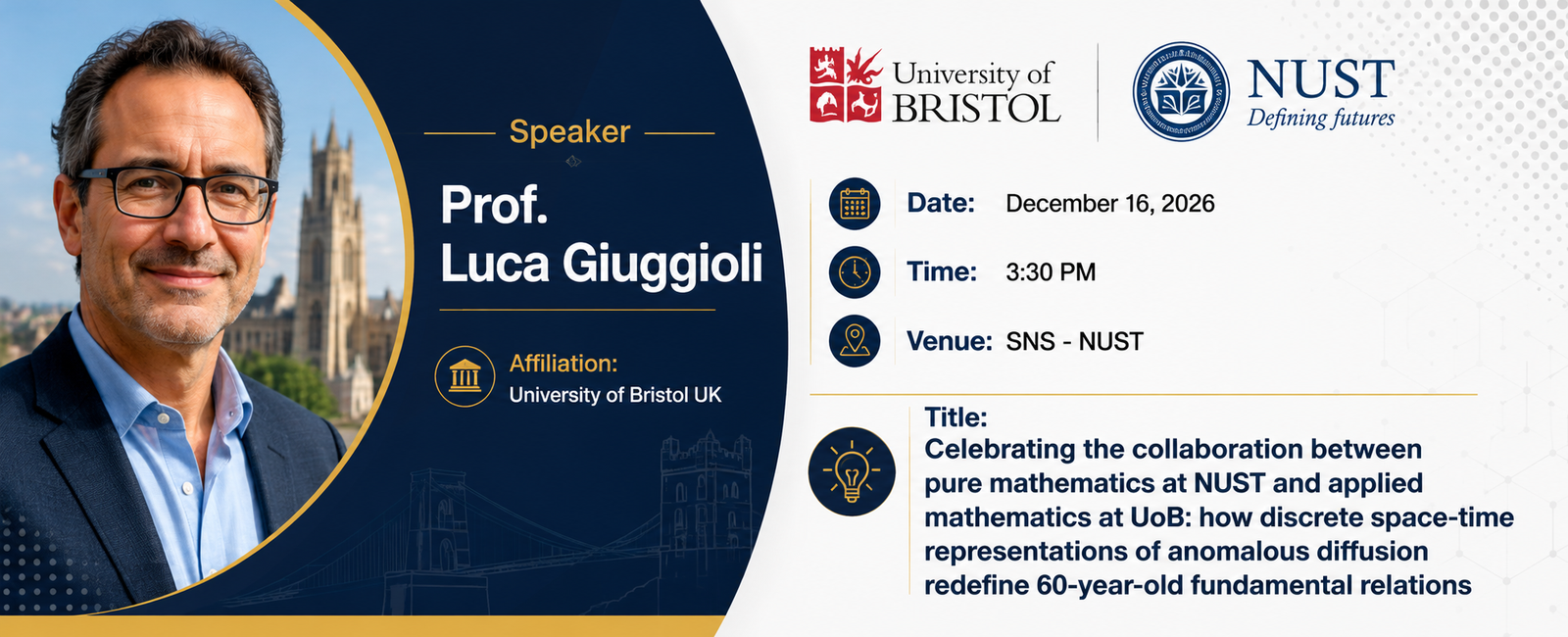
Over the last 15 months NUST and the University of Bristol (UoB) in the UK have engaged to develop a long-lasting collaboration to push the frontier of what we may refer to as the mathematics of movement, that is the collection of concepts, ideas, tools and techniques to represent the spatio-temporal statistics of randomly moving biological entities, such as macro-molecules, animals, cells or humans. Among the efforts aimed at growing the NUST/UoB interactions we have had an international workshop, a summer school, the supervision of various research Master’s students, multiple scientific seminars, various scientific publications, the ongoing development of a co-tutelle dual PhD mathematics degree, as well as the future goal of establishing an International Centre for the Mathematics of Movement with NUST, UoB and other foreign institutions, whose focus would be to attract underrepresented Muslim minorities to the field of mathematics. At the heart of the successes of these endeavours is the advantage of bringing together pure (NUST) and applied mathematics (UoB) to develop quantitative approaches in the form of mathematical models that probe the ubiquitous and fundamental mechanisms with which biological and ecological systems operate, namely how biological entities move and interact among themselves and with the environment.
The recent focus of our scientific efforts aligns with the ever increasing need to analyse and interpret the high resolution of modern tracking technologies which has brought further evidence that non-diffusive motion, often referred to as anomalous diffusion, represents the norm rather than the exception in biological organisms. While mathematical models to describe anomalous diffusion have been available since the 1960s, they have been based upon representations with continuous variables that limit their applicability to unrealistic one-dimensional and spatially homogeneous systems. Models with discrete space-time variables have instead been shown recently not only to avoid the pitfalls of using continuous variables, but also to account for the presence of arbitrary spatial disorder. Moreover, these discrete space-time approaches possess the additional advantage that they can be employed via exact analytical prescriptions, thus bypassing the limited interpretability of computational models, i.e. agent based simulations, their vast uncertainties and their prohibitive temporal burden. For this more technical part of the seminar I will introduce three new types of discrete-space time models that we have named the Discrete Generalised Master Equation (DGME), the Discrete Montroll Weiss Equation (DMWE), and the Discrete Fractional Diffusion Equation (DFDE). Among the evidence of their utility I will show how to prove their equivalence and present few examples of their applicability.